The Restoration Ecopreneurship in Practice: Innovation, Cacao, and Community in the Brazilian Amazon
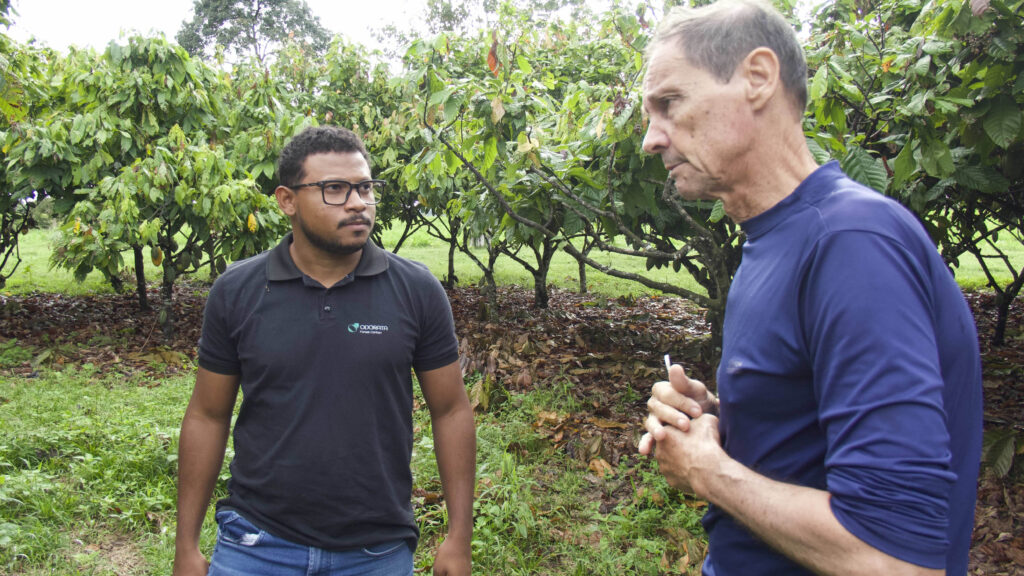
Emerson Neves and Renato Preuss showing us their cocoa agroforestry
Photo credit: UNCCD G20 GLI
When we launched the youth entrepreneurship activities of the G20 Global Land Initiative, one of our biggest hopes was to identify and support young people capable of transforming landscapes, economies and communities. Sometimes, however, the impact of these connections only becomes truly visible years later — when you finally stand in the middle of the forest and witness the story unfolding in front of your eyes.
That is exactly what happened during my recent trip to Altamira, in the Brazilian Amazon, to visit Emerson Neves.
I first met Neves during one of our G20 GLI trainings in partnership with Instituto Terra in Minas Gerais. Even then, his passion, curiosity, and entrepreneurial drive stood out. We encouraged him to apply for the 2025 Youth Ecopreneur Programme, and fortunately, he was selected. Throughout the programme, Emerson grew as an entrepreneur, gaining skills, knowledge and confidence, ultimately reaching the accelerator phase as part of the Top 25 ecopreneurs of the cohort.
Seeing young entrepreneurs grow through the programme is always rewarding. But being able to visit them in their territories, understand their realities and witness their impact firsthand is something entirely different.
On Monday, 11th of May, I reached Altamira and our first stop of the day was Emerson’s office inside the Xingu incubator in Altamira. It was inspiring to see a local incubator supporting young entrepreneurs during the earliest — and often most challenging — stages of building a business. These support systems are essential for turning ideas into viable enterprises, especially in regions where innovation and access to opportunities are still developing.
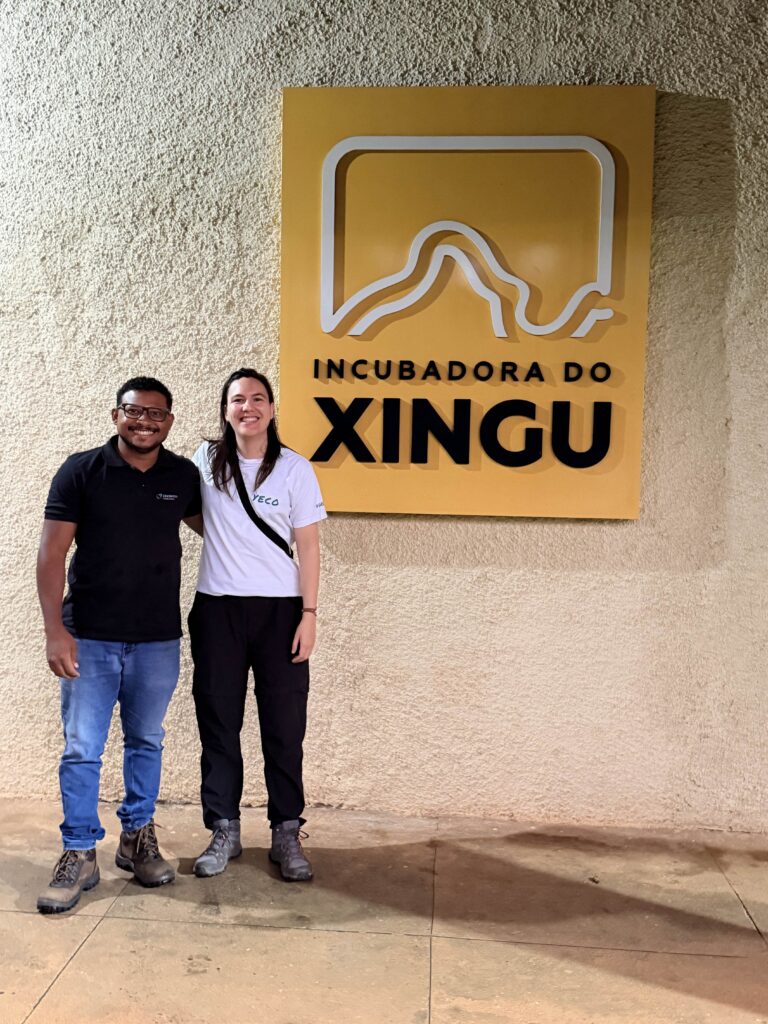
Emerson Neves and Paula Padrino visiting the Xingu Incubator
From there, we drove from Altamira to Brasil Novo, deeper into the region where his work is taking shape.
Neves is the founder of Odorata Forest Carbon, a business focused on forest restoration and carbon initiatives in the Amazon, connecting environmental conservation with sustainable economic opportunities for local communities. His work sits at the intersection of restoration, climate action and bioeconomy — exactly the type of entrepreneurship we believe is essential for the future of land restoration.
During the visit, he took us to one of his projects developed in partnership with Santa Catarina Farm.
There, we met Renato and Verônica Preuss, the owners of the property. Historically, the land had been used for cattle ranching, like so many others across the Amazon. But years ago, the couple decided to take a different path and began planting cocoa in an agroforestry system.
As the cocoa activities evolved, they also began planting native tree species throughout the property. Gradually, what started as a small initiative transformed into a more structured agroforestry system — combining cocoa production with native species restoration and conservation.
At some point, they realized it no longer made sense to maintain both systems: cattle and cocoa. The land, and their vision for its future, had changed completely. They decided to focus entirely on cocoa and agroforestry, transforming not only the business model of the property, but also its purpose.
What makes the story more memorable is that in 2019 they started a chocolate production business and launched a brand called Kakao Blumenn, which, since then, has been receiving various national and international recognitions, both in the chocolate category and for the quality of the cocoa bean.
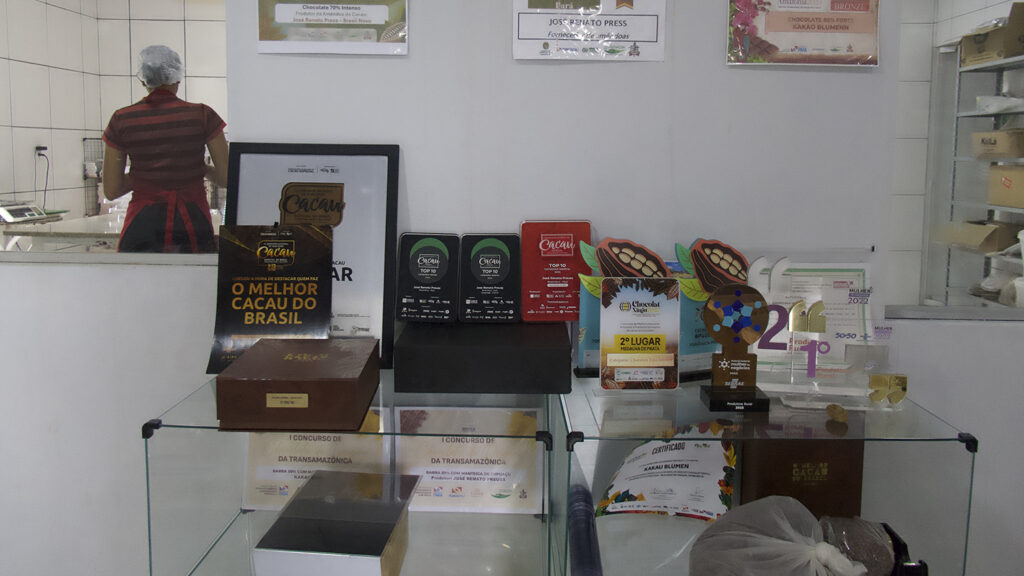
Awards earned by Kakao Blumenn both national and international
Kakao Blumenn was born from the desire to produce healthy chocolate, using selected cocoa beans from Santa Catarina Farm, where the process is carried out with great care, from harvesting and fermentation to drying, bringing out their full potential for proper roasting and refining, and transforming the bean into a chocolate with a unique flavor.
On the farm, roles are well divided. While Renato Preuss takes care of the cocoa bean production, Verônica leads the chocolate production and sales through Kakao Blumenn. Verônica Preuss is a woman deeply engaged with the rural farming community of Brasil Novo. As a way to further contribute to regional development and women’s empowerment, since 2021, she has been promoting courses and workshops that teach other women in the community how to also produce chocolate and start their own brands.
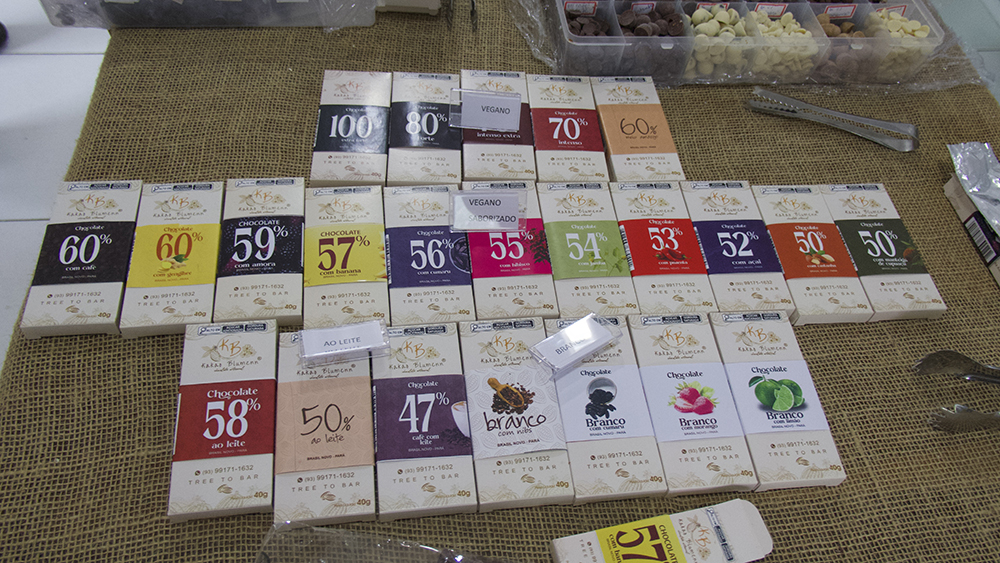
Chocolate selection from Kakao Blumenn
Today, Neves works alongside Renato and Verônica Preuss on two fronts: developing a carbon pilot project and supporting restoration efforts connected to the agroforestry system.
As we walked through the property, surrounded by cocoa trees and recovering forest, I told Renato Preuss how inspiring it was to see established landowners opening space for young entrepreneurs like Neves. His answer stayed with me. He said his property is open to anyone who wants to innovate and change the world.
There is enormous potential for landowners across Brazil and beyond to see restoration not as a limitation, but as a business opportunity — one capable of generating income, restoring ecosystems, empowering communities and creating long-term resilience.
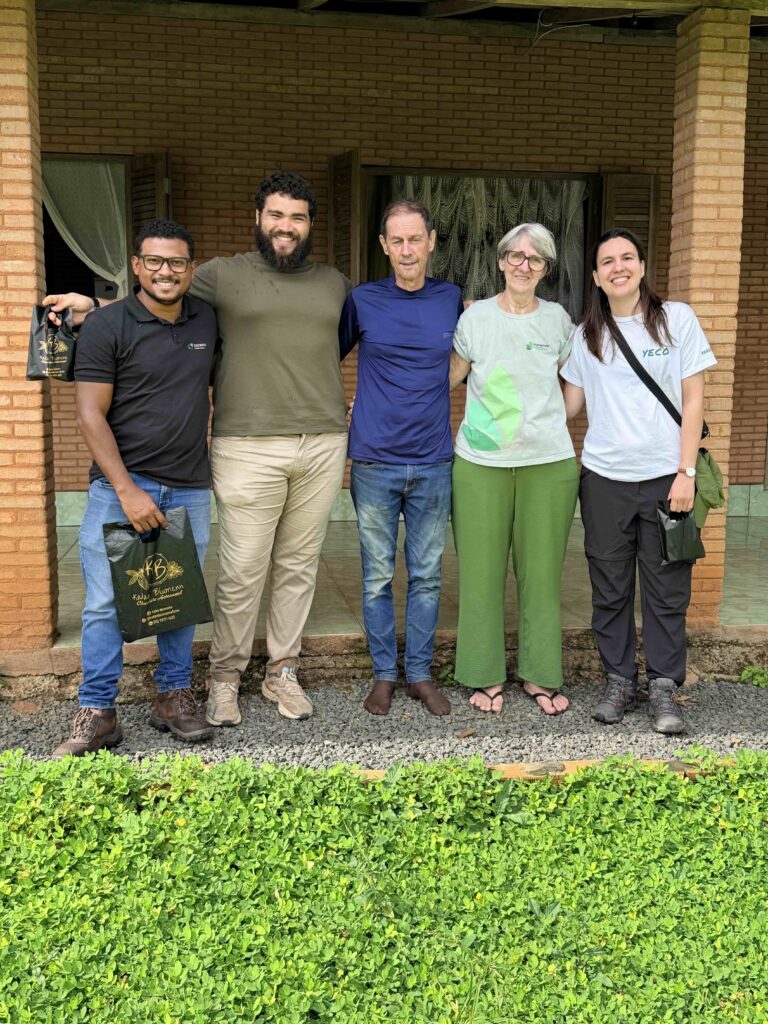
left to right, Emerson Neves, Jorge Augusto, Renato Preuss, Veronica Preuss, Paula Padrino Vilela
This is the restoration economy in practice.
And perhaps most importantly, this is what happens when experienced producers, young entrepreneurs, women leaders and local communities come together with a shared vision for the future of the land.