From knowledge to action: How the G20 Global Land Initiative’s online courses are empowering the next generation of land restoration leaders
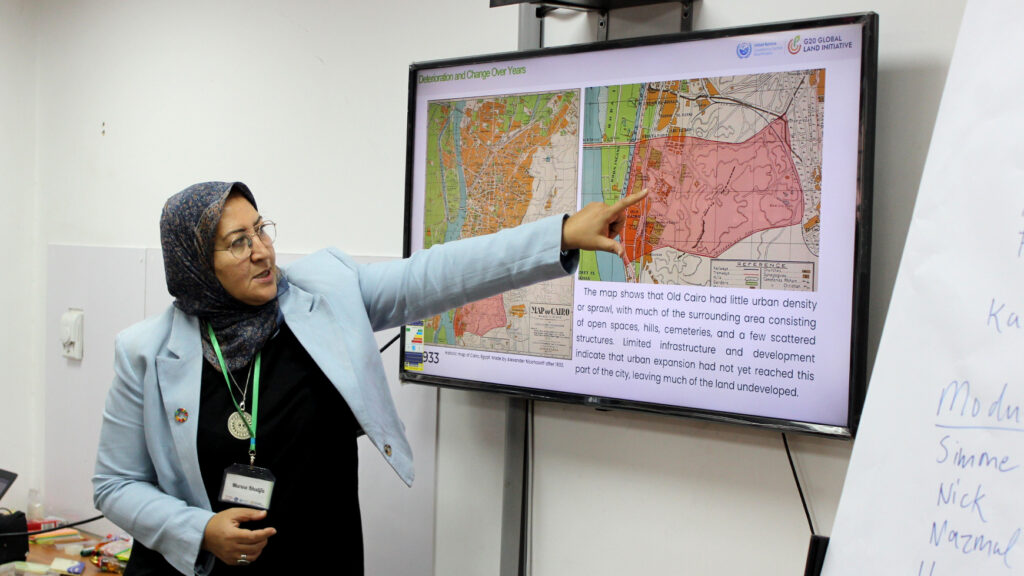
Prof. Marwa Khalifa, Vice Dean for Postgraduate Studies and Research, Faculty of Engineering, Ain Shams University (ASU), Egypt, during the “Trigger Change! Sustainable Urban Land Restoration” blueprinting workshop, November, 2024. Photo credit: Faculty of Engineering, ASU
Land restoration is one of the most defining challenges and opportunities of our time. Degrading land affects food systems, biodiversity and community livelihoods. This makes restoring depleted lands one of the most powerful pathways to healthier ecosystems and thriving communities, and why the Group of 20 (G20) countries made capacity building a key starting points for restoring land.
Not surprisingly, two open-access University courses on land restoration, designed for educators and practitioners teaching agriculture and urban planning have spread quickly.
Since its launch in 2024, Trigger Change! Innovative Sustainable Agriculture Solutions for Land Restoration has been downloaded over 1,200 times by educators in over 130 countries. Similarly, since its launch almost one year ago, Trigger Change! Innovations in Sustainable Urban Land Restoration, has been downloaded over 250 times by educators in 75 countries.
These numbers are striking as are the experiences by the educators using the courses, in terms of the course approaches, practicality and relevance both globally and locally.
A Holistic Approach
The urban course explores how cities can restore degraded land while enhancing resilience, biodiversity, and quality of life. Instead of focusing narrowly on site cleanup, the course encourages students to see urban land through the broader, systems lens.
According to Professor Marwa Khalifa, Faculty of Engineering at Ain Shams University in Cairo and one of our course developers, the program’s uniqueness lies in its integrated perspective.
“Restoration of degraded land goes beyond simply cleaning up contaminated sites or regenerating brownfields,” she explains.
“It incorporates the importance of ecosystem services and nature-based solutions in urban areas for promoting resilient, healthy and sustainable cities. Also, its transdisciplinary nature and its pedagogy, which is highly interactive and engaging through a combination of theoretical frameworks, case studies and hands-on exercises, [the] students will explore methods for restoring urban sites, implementing NbS [nature-based-solutions] and designing multifunctional urban spaces,” she adds.
Transforming Knowledge into Action
The urban restoration course focuses on landscapes and ecosystems. The agricultural course tackles human behaviour, a critical dimension of land restoration, and equips students with tools to design and lead initiatives that drive real change.
But the courses’ interactive formats also stand out.
“The course was so well received by my students that they requested that I teach it on Saturdays, beyond the regular teaching schedule,” says Professor Ernest Afrifa from the University of Cape Coast in Ghana, with reference to the agricultural course.
He describes the discussions, real-life case studies and collaborative learning as an exciting novelty for his students.
Mr Michael Aboah from the University of Cape Coast in Ghana, says the course was both intellectually stimulating and deeply practical.
It is “a transformative experience that deepened my understanding of behaviour change strategies in real-world contexts…. It strengthened my ability to analyse social and institutional barriers while equipping me with practical tools for designing sustainable interventions,” he explained.
Learning That Travels Across Borders
Among the most powerful aspects of these courses is their global reach. Both are designed as open-source resources. The agricultural course is available in English, Spanish and Arabic, with plans to add at least two more languages soon.
“The course offers interdisciplinary perspectives that help students connect land restoration, agriculture, climate change and socio-economic systems. Making the course open-source and accessible in multiple languages significantly enhances its global relevance,” says Dr Dyah Hizbaron, Department of Environmental Geography, Universitas Gadjah Mada, Indonesia.
Dr Hizbaron noted that both courses are easily adaptable to local contexts and include case studies from around the world.
Impact on the Ground
Although the courses are designed mainly for professors teaching university students, a large number of non-governmental organizations (NGOs) are downloading the courses and adapting them to their needs, more specifically as catalysts for new initiatives and stronger community engagement.
Samba Faye, chief executive and founder of Plantation Nurseries, a Green Climate Social Enterprise working on sustainable agriculture and climate resilience in The Gambia, describes the agricultural course as “highly transformative.”
“The course strengthened my understanding of land restoration, leadership and community-driven action…. It has directly influenced how I design and implement restoration initiatives, particularly in engaging youth and local communities,” he says.
Beyond technical knowledge, the course is helping participants to build professional networks and partnerships across various countries and disciplines.
Paul Ole Leitura, founder of Tanzania-based Mulika Afrika, says he is already applying lessons from the course while working with Maasai communities.
“The training strengthened my understanding of community-led change. It helped improve how we work with Maasai communities through participation, dialogue, and local ownership of development activities,” he says.
These real-world applications demonstrate the courses’ central goal: turning knowledge into practical action for land restoration.
The Restoration Leaders of Tomorrow
As the global community restores degraded ecosystems and builds climate-resilient societies, education can and will play a critical role. The Trigger Change! courses demonstrate how accessible, interdisciplinary learning can empower people across sectors and geographies.
By blending scientific knowledge, practical tools and community perspectives, the courses are helping students, educators and practitioners to move towards informed action, whilst contributing to global knowledge production.
In essence, these courses represent an early contribution, a single part of the broader collective effort needed to help communities nurture thriving landscapes.
As Professor Marwa Khalifa aptly reminds fellow educators, “you are shaping the restoration leaders of tomorrow.”