Ecopreneurs answer your questions on green business and our planet
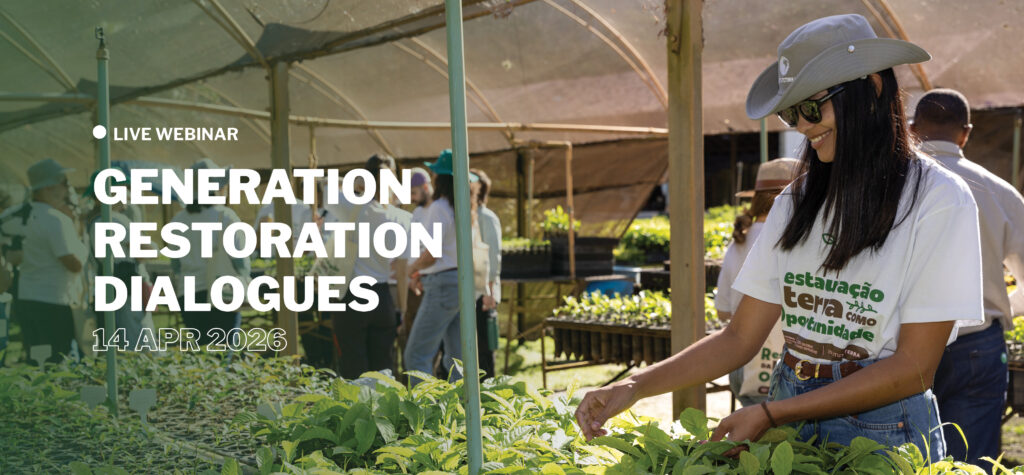
Photo credit: UNCCD G20 GLI
Ecopreneurship. This new approach to business blends the traditional fervor of entrepreneurship with the pertinent issue of creating sustainable solutions for our planet. Opportunities abound as the demand for environmentally friendly practices increases. Some savvy young leaders have seen the potential here and shared observations from their own experiences with us.
Paula Medina Agromayor, co-founder and COO of Féro, and Carlos González, co-founder and CEO of PACCHAR, joined our Generation Restoration Dialogues webinar in April to discuss growing opportunities in ecopreneurship. The conversation offered practical insights into the challenges young business leaders face, strategies for attracting investment and ideas for growing a green business from the ground up.
Féro operates primarily in Senegal, building affordable bamboo greenhouses and cold storage systems using local, environmentally conscious materials. Féro’s model includes agroforests that restore the land around their greenhouses, strengthening farmers’ livelihoods and productivity.
PACCHAR is an Ecuadorian biochar company transforming agricultural waste into high-quality organic fertilisers. PACCHAR’s model helps revitalise degraded soils while supporting the livelihoods of rural farming communities.
Catch the replay of the webinar
The conversation didn’t stop there though — we followed up with both of our ecopreneurs after the session to get answers to some of our audience’s most pressing questions.
Here are some of Paula Medina Agromayor’s answers about Féro.
How was the process of creating Féro’s technology?
Through our research, we learned that most smallholders in Senegal were only farming during the three-month rainy season and that their productivity was very low. We also learned that land degradation was a serious challenge in Senegal. This led us to pursue a key question: How could we design a profitable farming system based on reforestation for smallholder farmers? Agroforestry was a perfect option, as it involves planting diverse trees with high economic value. However, trees take time to mature and generate significant income, so we had to combine it with something else.
We knew that the greenhouse industry is very profitable, so we thought: why not adapt this technology at a smaller scale for the Senegalese context? We wanted to use local materials, so we started conducting structural testing with bamboo and learned that it was the perfect material for our greenhouse. We then used Féro’s engineering background to finalize the design and create an affordable and sustainable model. How do greenhouses cool the climate inside them? Don’t they usually keep the inside climate warm?
How do greenhouses cool the climate inside them?
In Europe and other regions with cold winters, greenhouse systems need to increase temperatures to keep plants healthy. In other settings, the opposite is true: temperatures are so high that they must be reduced for plants to grow comfortably. This is the case in Senegal, where temperatures can reach up to 40°C, while the ideal temperature for crops such as tomatoes is between 24 and 28°C. We use a combination of mechanical and evaporative cooling to reduce the temperature.
Does Féro utilise smallholder farmer land to put up the structure?
Féro partners with smallholder farmers through a joint-venture model and a profit-sharing scheme. Smallholder farmers contribute land to the project, and Féro invests capital for the infrastructure. The annual profit is shared between smallholder farmers and Féro according to each party’s contribution to the total project cost. The 10-year partnership period before transfer of ownership also ensures that smallholder farmers have sufficient time and training to become fully autonomous in managing the farms.
In your view, what defines a truly successful green business today? What trends should aspiring ecopreneurs pay attention to right now? And what gives you hope about the future of sustainable business?
A truly successful green business is one that has a clear and structured plan to generate revenue while simultaneously having a positive impact. This impact can take many different forms, such as land restoration, biodiversity conservation, carbon sequestration, and water management. Some important trends to pay attention to are the solutions that scientists and experts identify as key to reversing climate change. More and more funding is also being directed toward private-sector companies focused on green innovations, which is very encouraging.
Carlos González also answered questions about PACCHAR
How is the demand for biochar? Do you recommend its use in any type and carbon content of soils?
The market is growing in Ecuador and globally, now that farmers understand the concept and it is backed by science publications with good agronomy results. Biochar can be used in any type of soil; however, it has better results in degraded soil.
What were the major challenges for your initiative?
Achieving credibility for my products and making the first sale. It took me two years of R&D to make the first sale. Now that business is growing, the challenge is to prevent others from taking it over. So investing in IP, lawyer advice, etc. is a good idea for scaling it up peacefully.
How can indigenous knowledge be better recognized in global innovation ecosystems?
Modernize indigenous knowledge with science: objectively prove that it has a positive impact. You can do this by partnering with universities or research institutions. Then recognition comes through a marketing strategy. This combination is a “purple cow” for global visibility.
The ecopreneurs came together to answer your general questions about green business
What types of financing mechanisms (grants, blended finance, impact investment) are most accessible and realistic for early-stage ecopreneurs in developing countries?
Medina Agromayor: In Féro’s case, we experienced challenges attracting impact investment before generating revenue. Grants have been a key element of our funding strategy. There are many funding opportunities throughout the year, but they are extremely competitive, so mastering the way you communicate your story is key.
Carlos González: Angel investors’ funding or equity investment. Definitely don’t go into debt until you have a sustained cashflow.
How can ecopreneurship models be designed to remain both scalable and inclusive, especially ensuring participation of marginalized and climate-vulnerable communities?
Medina Agromayor: It is important to develop an innovation that directly engages and benefits vulnerable communities. They are often the ones with the deepest knowledge of the territory and ancestral adaptation practices. They are strategic partners to work with. If your innovation creates value both for your company and for the communities you work with, it will scale organically.
González: Secure a revenue stream for both your company and your rural stakeholders. Be transparent in accountability and take care of your communities.
We hope this dialogue was insightful and left you with inspiration for leadership and change. Ecopreneurs like Medina and González show us that sustainable, profitable action is possible and immensely valuable, and that the world of business and positive, real-world environmental impact are not diametrically opposed.
Be sure to register for our upcoming webinar, “The Future of Food Systems,” on May 19, from 2:00 to 3:00 PM CET. In alignment with our upcoming COP17 agenda, we will discuss the growing need for sustainable food production and the solutions already taking shape in local communities on the ground.