Beyond Youth-Washing: How a Youth Programme is Driving Youth Leadership at Global Policy Events

© UNFCCC/Kiara Worth
Participants during UN Secretary-General António Guterres’s Youth Roundtable at COP30 in Belém, Brazil.
For many, the UN Climate Conferences (COPs) are primarily about negotiations, pledges, and political momentum. Yet year after year, another dimension becomes clearer: COPs are also spaces where young leaders and ecopreneurs gain visibility, build networks, and advance real solutions on the ground. As climate, biodiversity, and land agendas increasingly converge, youth-led ventures that already live these intersections daily, bring invaluable practical knowledge to the table.
Youth engagement in climate governance is not only symbolic but also necessary. Young people often navigate urgency, anxiety, and exhaustion as they push for climate justice. Still, they continue to lead, innovate, and expand public debate. As a response to this, the UN established at COP26 the Youth Climate Champions – at COP30, in 2025, the Youth Climate Champion was Marcele Oliveira, an important sign of how youth voices are shaping national and global conversations.
Beyond activism, the role of young entrepreneurs becomes even more relevant as private-sector actors and civil society gain more presence in negotiation spaces. For these young leaders and ecopreneurs, a COP is more than awareness-raising, it is a real-world learning and a chance to understand the policymaking process; meet legislators, activists, investors, and partners; and benchmark their solutions in a global arena. Few spaces compress so much learning, visibility, and opportunity into a single place.
Several young ecopreneurs who had already been engaged in different UNCCD/G20 GLI programmes were also present at COP30, both from our G20 GLI flagship Youth Ecopreneurs (YECO) programme and the first national ecopreneur capacity-building training with Instituto Terra, in Brazil and the UNCCD Land Heroes. That reinforced how these commitments continue to create tangible opportunities for youth participation.
Youth and ecopreneurs at COP30
COP30 in Belém became widely recognized as the COP of people, which brought this dynamic to life. From Brazil alone, the G20 GLI’s national capacity-building training accounted for 10 participants working on land-restoration solutions across different biomes who self-financed their participation. The global YECO programme added another nine ecopreneurs from outside Brazil, including youth-led ventures from Asia, Africa, and Latin America. And the Brazilian UNCCD Land Hero, Beatriz Azevedo, also a participant of YECO 2025, was also another important young-leader and now an ecopreneur part of COP30.

UNCCD Land Hero, Beatriz Azevedo (left) had the chance to meet Deputy Executive Secretary of UNCCD, Andrea Meza Murillo, at COP30, in Belém.
Beatriz explained that her trajectory as an entrepreneur began directly from a COP experience. After participating as a Land Hero at COP16 in Riyadh (2024), she said the experience “completely shifted how I saw my role as an entrepreneur in restoration and water business,” adding that meeting senior UNCCD leadership at COP30 “expanded my network and reinforced how youth-led initiatives can influence global agendas.”
From India, YECO participant Sourabh Sathya Sindhe, founder of Organic Microgreens Private Limited (OMG), reflected on the unique environment in Belém. He noted that taking part in COP30 was “deeply enriching, especially at a COP where civil society and Indigenous peoples were so strongly represented,” highlighting how this proximity strengthened his sense of global community and responsibility.

Catharina Vale and Sourabh Sathya Sindhe, YECO from OMG met in the COP30, Belém
For Tomaz Stahl Martins, from the Brazilian startup MAÇAIX, COP30 marked his first participation and a milestone. His startup was recognized by Embrapa, public company for agricultural research, development, and innovation linked to the Ministry of Agriculture and Livestock (MAPA), as one of the Top 10 Startups COP30.
Tomaz described the experience of presenting at multiple side events and winning an entrepreneurship challenge as “a turning point for our work on climate-resilient forest-based businesses,” showing how a COP can accelerate both learning and investment pathways for ecopreneurs. Another winner among Embrapa’s Top 10 Startups COP30 was Fernando De Lucca, of Ceres Seeding, who had previously participated at COP16 in Riyadh. Both Tomaz and Fernando are YECOs and participated in the Capacity Building programme with Instituto Terra.
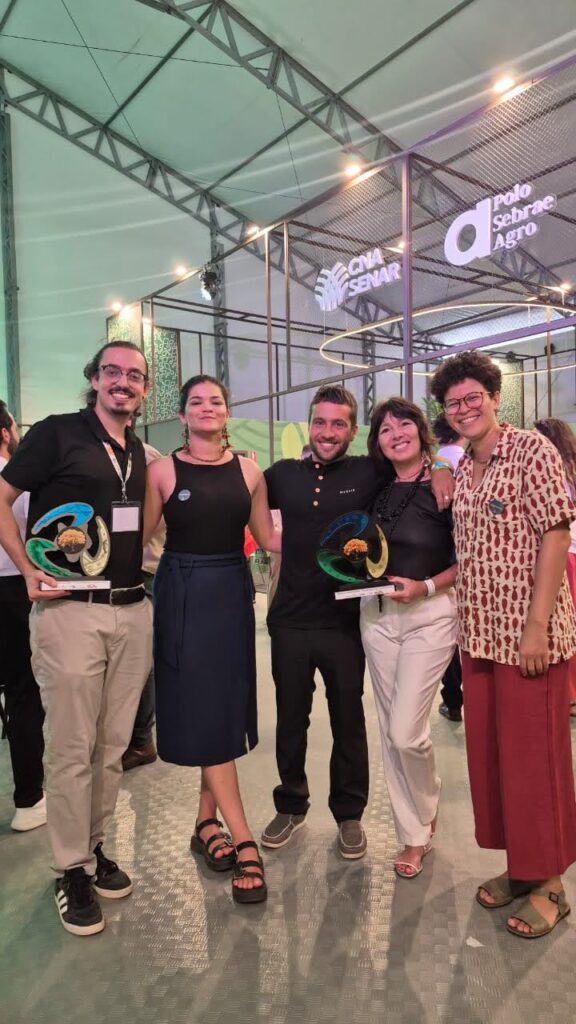
At the Embrapa’s Top 10 Startups COP30, from left to right, Brazilians ecopreneurs that participated in the Capacity Building programme of G20 GLI: Fernando De Lucca, Madalena Ferreira, Tomaz Stahl, Anelise Stahl and Bárbara Pacheco.
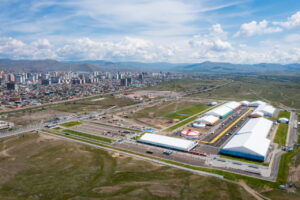
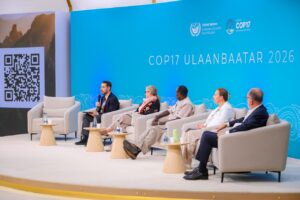
Looking ahead: toward COP17 in Mongolia
The lesson from Belém is clear: ecopreneurs are uniquely positioned to embody the connections between the Rio Conventions, because their daily work already integrates climate mitigation, biodiversity protection and land restoration. Their presence in negotiation spaces helps translate global commitments into grounded, actionable pathways.
Looking toward COP17 of the UNCCD in Mongolia, the expectation is to see even more young innovators and restoration entrepreneurs shaping the debate and connecting policy with practice, science with culture, and global ambition with local impact. COPs will continue to evolve, but one thing is certain: youth leadership and ecopreneurship are no longer peripheral to climate action, but central to its future.