Rio Synergies Group for Action officially launched at COP31
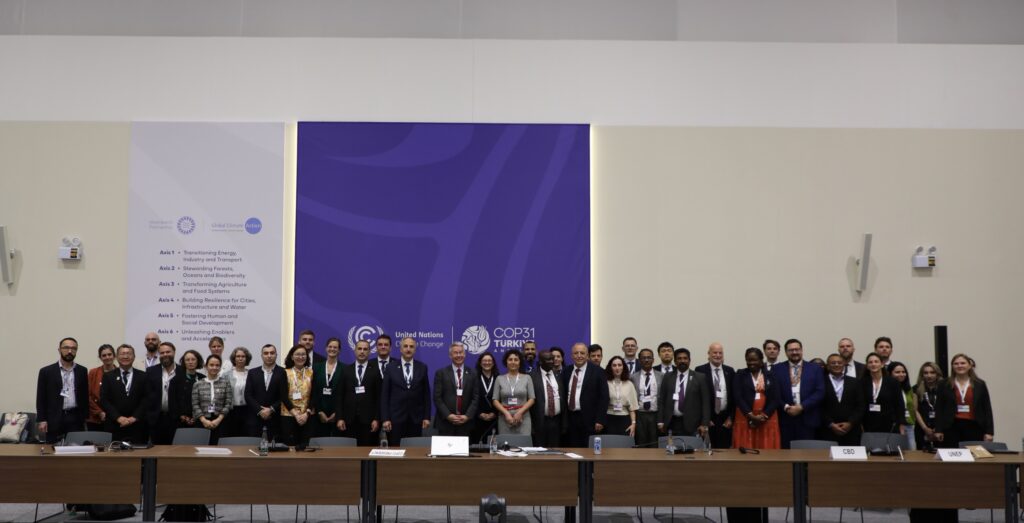
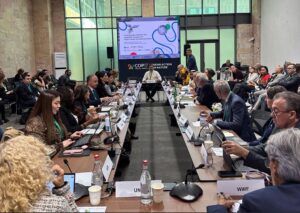
33 countries and 19 organizations joined the Rio Synergies Group for Action at its launch during the High-Level Dialogue on Rio Synergies Day at UNFCCC COP31 in Antalya, Türkiye.
The voluntary, country-led Group provides a space for countries to showcase existing and planned work on Rio Synergies and share what they have learned. It also gives countries and partners a space to explore how existing expertise, programmes and financing opportunities could support national priorities across climate, biodiversity and land. Countries retain ownership of their actions, and participation does not create new obligations or reporting requirements. Speaking on behalf of the COP31 Presidency, H.E. Hasan Suver, Deputy Minister of Environment, Urbanization and Climate Change, said the Group was intended to show how countries could deliver better results by implementing their existing commitments together.
Integrated implementation, across distinct mandates
UNCCD’s Executive Secretary Dr Yasmine Fouad summed up the rationale in her message to the launch. “On the ground there is only one landscape.” Climate change, biodiversity loss, desertification, land degradation and drought affect the same landscapes and communities. UNEP Executive Director Inger Andersen reinforced the case for integrated implementation: “The coherence between climate, biodiversity and land is a necessity, not an aspiration. And from an ecological point of view, it is indisputable. From a community point of view, it is a reality”. H.E. Hasan Suver from the COP31 Presidency emphasized that stronger cooperation must respect the distinct mandates of the three Conventions: “Our goal is not to merge the Conventions, but to scale up countries’ collective impact on the ground”.
Country interventions brought the implementation challenge into focus. Panama stated that that “integration at home is not enough if support stays fragmented”, while Germany stressed that the Group “should systematically seek to integrated existing initiatives and avoid duplication”, and the United Arab Emirates underlined their commitment “to work with the future Rio Convention Presidencies to turn this cooperation into real and measurable action on the ground”.
Organizations participating at the launch outlined ways to support country-led action. ICLEI Secretary General Gino Van Begin called on Parties to involve local and regional governments, “because that is where synergies become action”. Highlighting restoration as a concrete pathway, WWF Global Climate and Energy Lead Manuel Pulgar-Vidal noted that “restoration is one of those key synergistic ways in which we can achieve our objective”. IUCN Deputy Director General Stewart Maginnis concluded that “synergies must strengthen implementation, not dilute commitments; reduce burdens, not create new ones”.
From Antalya through Ulaanbaatar and Yerevan back to Antalya
Türkiye set the process in motion in May 2026 by convening the Strategic Antalya Dialogue under the G20 Global Land Initiative. Those discussions laid the groundwork for the proposed Rio Synergies Group for Action. Türkiye formally launched the Presidency process to establish the Group at UNCCD COP17 in Ulaanbaatar. Working with the COP17 Presidencies of Mongolia and Armenia, Türkiye took the process forward at CBD COP17 in Yerevan and officially launched the Group at UNFCCC COP31 in Antalya.
The G20 Global Land Initiative’s Coordination Office, hosted by UNCCD, supported Türkiye’s COP31 Presidency throughout the process. As part of this, it also supported the high-level dialogues led by the three presidencies of the three Rio COPs and co-organized the Technical Dialogue Series with Turkiye, the COP31 Presidency, and IUCN and the ENACT Partnership. The consultations and dialogues helped identify what countries wanted to take forward, what was holding up implementation and where partners could help.
Speaking in his capacity as the Chair of the Technical Dialogue Series, IUCN Deputy Director General Stewart Maginnis summarized the main outcomes of discussions throughout the technical dialogue series: Parties emphasized that synergies should be practical using existing pathways – such as nature-based solutions, energy transition or regenerative blue economy – without creating new institutions or reporting burdens. Greater efficiency must not justify backtracking on financial commitments under the three Conventions, and delivery requires coordination among policies, budgets and ministries alongside a meaningful whole-of-society approach.
The way forward
With 33 countries and 19 organizations joining the Rio Synergies Group for Action, the Group has established a strong foundation for continued cooperation. The United Kingdom’s Special Representative for Nature, Ruth Davis, outlined expectations for this next phase: “We look forward to the Group for Action focusing very particularly on practical cooperation, on shared learning and on tangible results from existing commitments”. Türkiye’s COP31 Presidency emphasized that “the value of this Group will be measured less by statements here than by the partnerships built after COP31”, while Dr. Yasmine Fouad, Executive Secretary of the UNCCD, suggested to measure the success of the Group by “the investments it helps to unlock and the results it brings on the ground”.