For the first time Kenya’s drylands farmers are farming with their eyes open
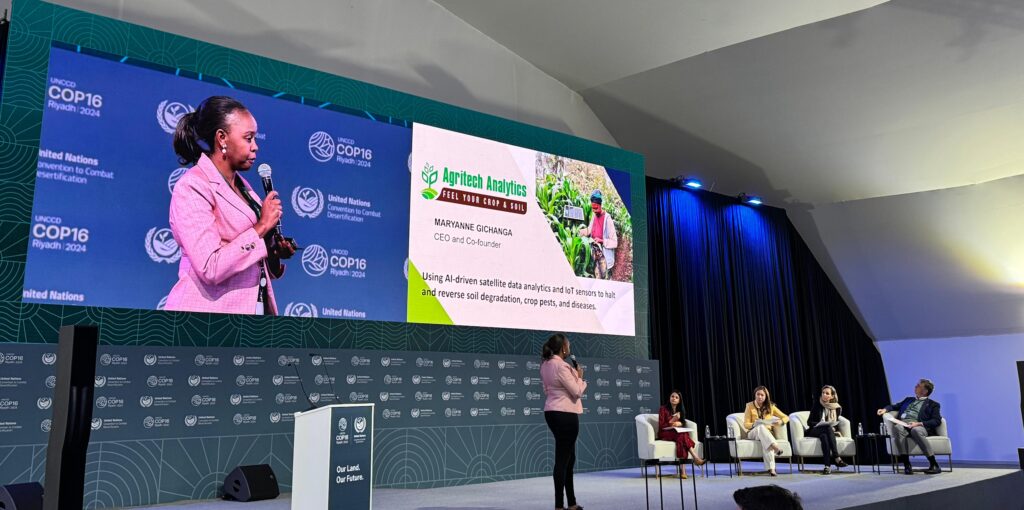
Photo credit: UNCCD/G20 Global Land Initiative
When Maryanne Gichanga stepped onto the UNCCD Land of Opportunities stage at COP16 in Riyadh, she was not arriving alone. She was representing the new generation of innovators shaped and supported through the Youth Ecopreneur Programme (YECO) — a platform designed to help young leaders turn restoration ideas into scalable solutions.
Competing alongside finalists from across UNCCD programmes, including fellow YECO alumni, Land Heroes and the Great Green Wall Accelerator, Gichanga carried with her more than a company. She carried the realities of Kenya’s dryland farmers: degraded soils, unpredictable weather, pest outbreaks and the steep barriers that women and youth face in accessing modern agri-tools.
Her venture, AgriTech Analytics, was already working directly with farmers, offering a simple but powerful promise: technology that works for the last-mile farmer, in their language, on their terms.
What she delivered on that stage earned her the top prize —securing a grant of USD 50,000 provided by InTent— marking a new chapter not only for her company, but for Kenya’s restoration and agricultural landscape. What unfolded afterward illustrates why youth-led innovation cannot remain on the sidelines of global development.
Gichanga did not treat the USD 50,000 prize as a trophy. She treated it as fuel. With it, she began deploying Internet of Things (IoT) devices across Kenya’s dryland counties; tiny pieces of hardware able to detect pests faster, diagnose soil health in minutes, alert farmers in their own languages and give them back control over their harvests that climate uncertainty had stolen.
Within months, 584 devices were in the hands of farming families, each shared among four smallholder farmers at a time. Thousands of farmers—2,336 every month—were suddenly receiving real-time updates in 17 local languages about soil nutrients, pests, diseases and weather risks. Over a year, that reach rises to 28,032 farmers—a scale unthinkable before COP16.
But Gichanga was not done.
One of her most strategic moves was creating 30 demonstration farms in Makueni, Embu and Kirinyaga. These were not symbolic pilot sites—they became community classrooms. On any given week, you could find dozens or even hundreds of farmers gathered under a tree or beside a greenhouse, learning how to manage pests sustainably, test soil health quickly, use fertilizers more efficiently or understand market prices.
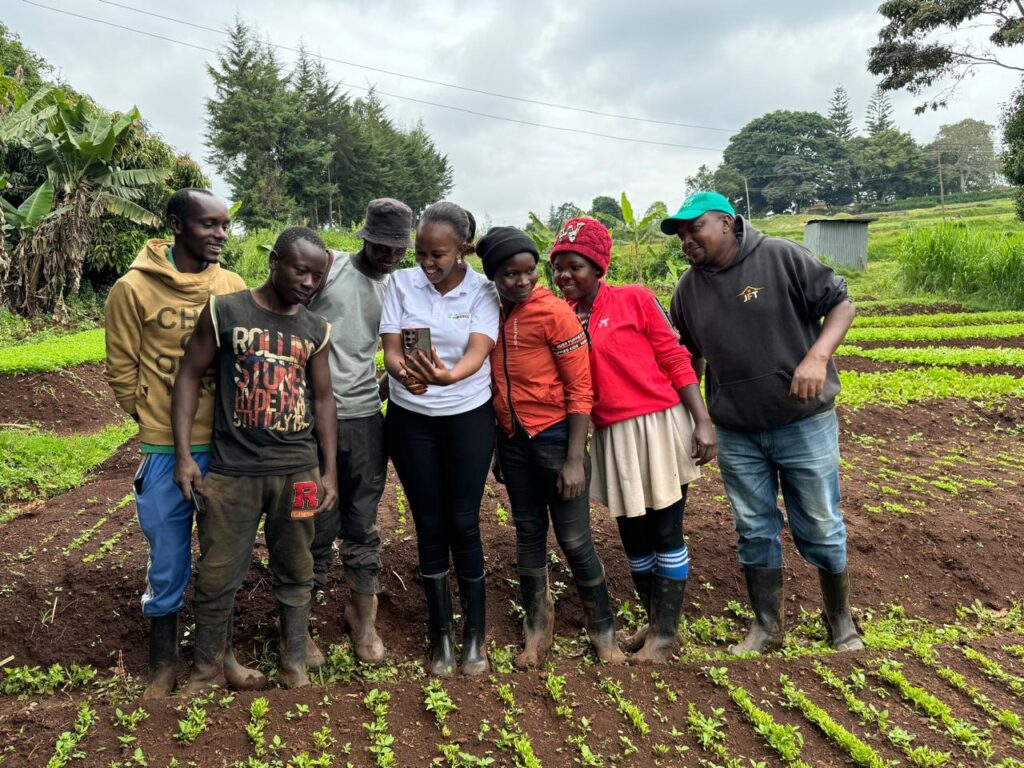
Photo credit: UNCCD/G20 Global Land Initiative
Over time, these fields blossomed into learning hubs that trained 15,270 farmers. More than half of them, 57 percent, were women. Women who often carry the heaviest burden of land degradation, and yet have the least access to technical support.
As the upgraded IoT device came into use — now able to identify 300 pests and 290 crop diseases, and to run soil diagnostics in under two minutes — farmers began reporting changes that were nothing short of life-altering.
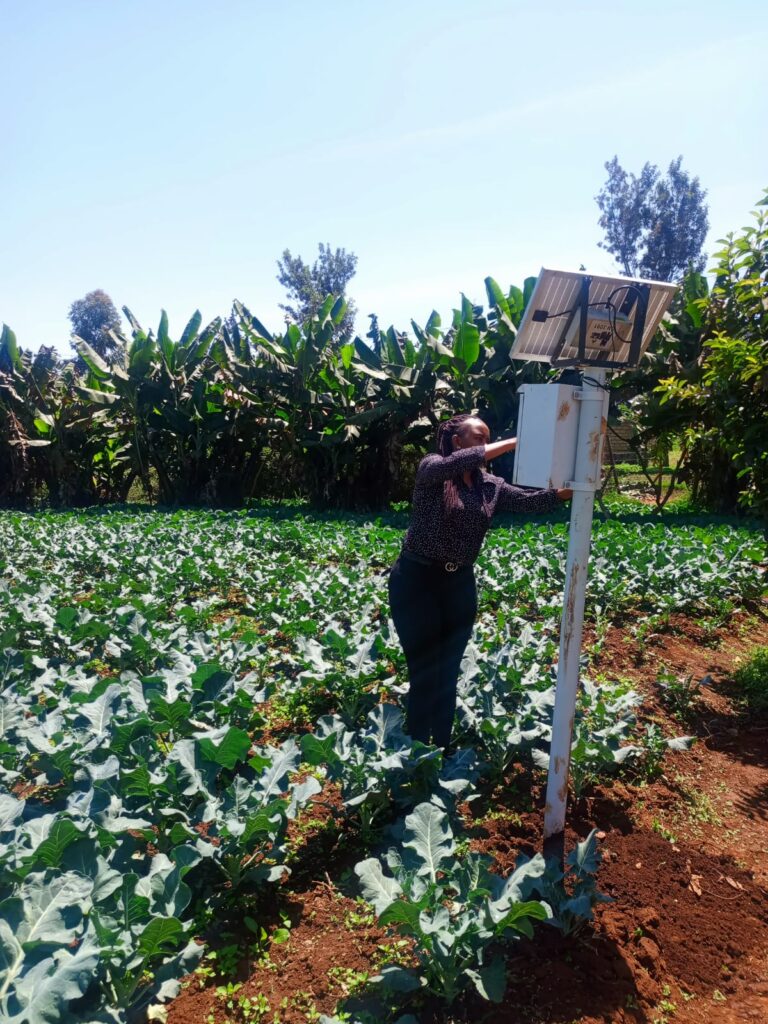
Photo credit: UNCCD/G20 Global Land Initiative
In Makueni, a maize farmer named James Mutua shared how a simple early alert saved his season’s crop. The device warned him about the threat of a fall armyworm before he even noticed the first signs. He treated his field early and harvested 22 bags of maize instead of 13, raising his earnings from $243 to $420.
In Kirinyaga, Grace Wanjiku, a tomato farmer, saw her yields surge from 18 crates to 29. With the extra earnings, she repaired her greenhouse and paid school fees for her son. Her training on precise fertilizer use saved her over KES 5,500 ($43), and for the first time, she said, “I feel like I’m farming with my eyes open.”
Across counties, similar stories emerged: yields rising by 66 percent, input costs dropping by 61 percent and average profitability soaring by 155 percent. These are not just percentages — they represent repaired greenhouses, school fees paid, loans repaid, harvests secured and livelihoods restored.
The InTent award not only transformed farming practices. It created livelihoods; 5 new full-time staff at AgriTech Analytics, 165 distribution agents and 1,692 young people taking part in the Crop Yield Aggregation Program. The project mobilized youth at every stage, from device distribution, training and field support, to data collection, bringing a new generation into the heart of Kenya’s restoration economy.
Maryanne’s leadership soon attracted national attention. Following the COP16 win, AgriTech Analytics was invited to speak at five national innovation forums. County governments reached out to explore collaboration. The Government of Kenya recognized her Crop Yield Prediction Tool for its potential to help youth and women farmers qualify for agricultural loans, an enormous step toward inclusive financing.
Through it all, Maryanne stayed grounded in the same mission she began with: using technology to restore soils, increase productivity and empower farmers.
“Thanks to the UNCCD Land of Opportunities and the InTent grant, we’ve shown that technology, combined with training and strong local partnerships, can empower smallholder farmers to combat and reverse soil degradation, crop pests and diseases for higher yields, and restore soil health across Kenya’s drylands.”
— Maryanne Gichanga, Founder & CEO, AgriTech Analytics
Maryanne embodies the potential of a restoration economy powered by youth. Her work bridges technology and tradition, scaling modern tools while honoring community learning systems. It proves that land restoration is not abstract—it is measurable, it is economic and it is deeply human.
From YECO 2024 to COP16, she has shown what can happen when global platforms open their doors to young leaders. Farmers earn more. Soils recover. Innovation spreads, and rural economies grow.
Her story is not just hers. It is a blueprint for what youth-led land restoration can achieve everywhere.
Latest News
- Young entrepreneurs from Argentina, Uganda win UN global pitch contest at ChangeNOW: Youth Ecopreneur Awards
- UNCCD Executive Secretary Dr. Fouad welcomes Saudi Arabia’s landmark achievement in land restoration
- Saudi Arabia marks restoration of one million hectares of land, advancing global momentum on land resilience
- UNCCD G20 Global Land Initiative publishes 2025 annual report

- Eight finalists named for Youth Ecopreneur Awards

Upcoming Events